Every rabbit hole needs style.
Best practices in synchronized crime.
What Stuck, What Fell Away
As I extolled in my spring post, I was using everything I could get my hands on. That was fun, but unsustainable.
What stuck: ChatGPT Plus is my daily driver. Yeah, I upgraded. The subscription killed throttling, gave me persistent memory between chats, and expanded the context window. At work, Microsoft Copilot keeps Personally Identifiable Information (PII) and Intellectual Property (IP) safe, and has GPT-5, memory and custom instructions. I just like to keep work and personal separate. I have access to the Copilot for M365 as a pilot. It is genuinely useful, even if we’ll never afford it at scale.
What fell away: Claude, Mistral, Novelcrafter, RaptorWrite, Ollama. Too many caps, too niche, too awkward, too slow. Meta and DeepSeek never cleared my ethics bar. NotebookLM is parked: neat demo, not a habit. That said, the podcast feature is gold.
Lesson: broad, low-friction tools outlast niche experiments. My world has converged.
Rubric → 5 Approaches → Plan
<Instructions>
1. Identify the problem
2. Build a rubric for good solutions
3. Brainstorm 5 approaches
4. Evaluate each against the rubric
5. Recommend a plan
</Instructions>

<Content>
[Messy idea or problem goes here]
</Content>
How My Use Has Matured
The big shift: prompt engineering is (mostly) hype. These are language models. What matters is critical thinking and clear expression. People who can frame ideas well get more value, full stop.
- Sycophancy check. Left alone, the model nods along. Unless I tell it to argue with itself, or build a rubric, it won’t push back. That’s not collaboration, that’s flattery.
- New habits. I use it as a surrogate for journaling. Conference notes, counselling reflections—dump it all in, then have the bot organize and highlight patterns. Even better: tell it to ask one question at a time to fill gaps. That keeps me engaged without overwhelm.
- Boundaries. Brainstorming, outlining, rough-draft bullets? Yes. Finished prose? That’s mine. If I hand over the baton, I lose the music.
- Meta-habit. ChatGPT is now my default search. Google’s a fallback, and even there Gemini usually pops up first. The gravity has shifted.
Multi-Lens Text Analysis
<Instructions>
Analyze the following text with these lenses:
- Narration Types
- Scene Function
- Character
- Conflict & Stakes
- Worldbuilding
- Theme & Resonance
- Continuity & Cohesion
- Reader Experience
Provide strengths, weaknesses, recommendations.
Then: roll-up top 5 changes.
</Instructions>

<Content>
[Draft scene text]
</Content>
A Couple Quick Tips
Fence instructions from content with XML. This helps more than you think. I have examples all over the place. You got this.
Add an extra ending instruction: Think hard about this for deep dives, Quick answer only for brevity. This is a GPT-5 thing.
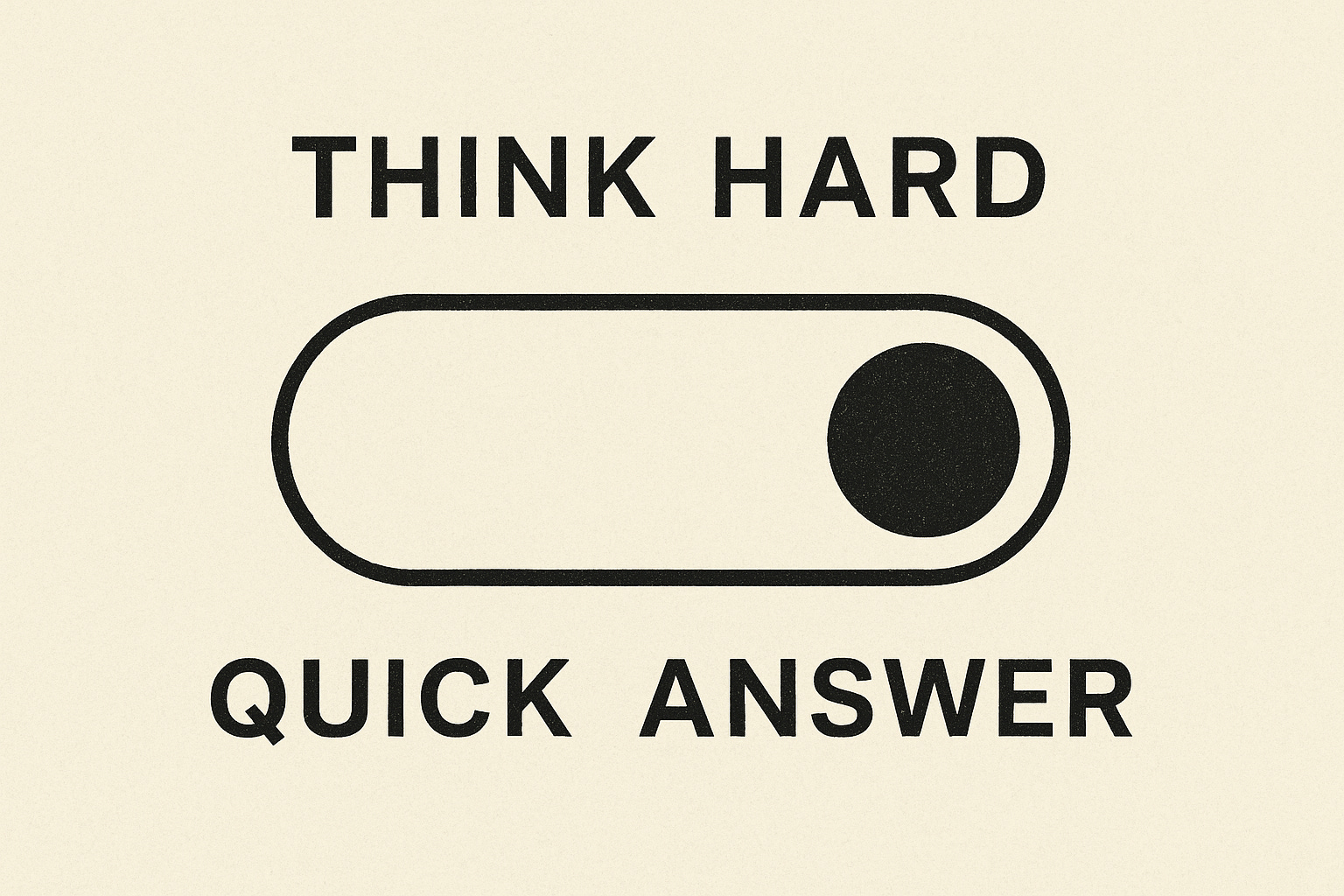
The only setting that matters.
Habits & Pitfalls
Anyway. The honeymoon’s over. I’ve learned where these tools shine—and where they happily feed into my worst instincts.
Wins
Conference & meeting notes. Dump raw notes, get back structured clarity. The one-question-at-a-time trick fills gaps without overload.
<Instructions>
- Identify missing info
- Ask me one question at a time until you have enough
- Then give me a summary of the session
</Instructions>

<Content>
[Session notes / themes]
</Content>
Rollup Summaries. Some conversations go way off the rails and it’s easy to lose context. Rolling up gives you an opportunity to see what’s there at a glance and to correct the LLM when it veers off into the rhubarb.
Read this entire chat and give me a detailed roll-up summary with decisions, next actions, open loops, risks, and ideas.
Narrative refinement. Simulated beta readers give me fast feedback. One or two rounds sharpen a draft. Any more and it turns to paste.
<Instructions>
Invent a panel of 5–7 simulated beta readers drawn from my target audience.
Each panelist should have a distinct voice and perspective.
Have them read the draft text and provide individual feedback only.
Do not generate suggestions or fixes from the panel itself—just feedback.

Then, roll up the panel’s observations into themes.
Finally, provide YOUR own consolidated recommendations for improvement
based on the feedback themes (not on the panel’s wording).

Output:
1) Panel feedback (by persona)
2) Thematic roll-up
3) Your editorial recommendations
</Instructions>

<Content>
[Paste draft text here]
[Define target audience here]
</Content>
Cautions
Bright Shiny Objects (BSO Trap). In my productivity workbench, the bot will happily rationalize any side quest. Without constraints, it colludes in distraction.
Story Drift. Characters and plots mutate unless I lock them into a bible and reload it. Continuity takes orchestration.
Over-Polish. Too many beta-reader rounds and the writing gets worse, not better. Trust your own judgement. Seriously. The phrase “turd-polishing” came from somewhere.

Me, every Monday morning.
Education-Friendly Use Cases
NSCC’s AI Policy is here and there’s lots to take in. Meanwhile, here are some use-cases that are already safe, repeatable, and effective.
For Students: Drop an OER textbook into Copilot. Tell it to answer only from that source. Use it to outline, generate study questions, or quiz you until you’ve nailed a concept. Save your prompt in Apple Notes (or whatever) for re-use. Neurodiverse learners can ask it to adjust for pace or clarity. Tailor it to how you learn.
You are my study coach. Only use the content from this textbook [paste/upload OER text]. Create a study outline, 10 practice questions, and a quiz. Ask me one question at a time and don’t move on until I answer correctly. Adjust your explanations for a [neurodiverse / visual / step-by-step] learner.
For Faculty: Feed in your outcomes and materials. Ask for multiple presentation outlines. Constrain by level, audience, or legislation. Custom instructions can embed your style once and re-use it forever.
Here are my course outcomes and materials [paste or upload text/slides]. Generate three possible presentation outlines for a 60-minute class. Each should take a different approach (interactive, case-based, structured lecture). Highlight which approach best fits first-year students. Then ask me if I want to combine or refine them.
For Everyone: Tell the bot to interview you like a New York Times reporter to design your custom instructions.One Q at a time, then it spits out a system prompt you can paste into settings.
Act like a New York Times interviewer. Ask me one question at a time to learn how I want this AI to behave when I use it. Cover tone, style, level of detail, things to avoid, and special needs. When you have enough, write a custom instruction/system prompt I can paste into my settings.
If you’re curious or you’re looking for an example to pilfer, here is my set of custom instructions I use in Copilot (and similar to the one I use in ChatGPT):
You are my trusted partner in thinking, planning, and creating.
Follow these rules when working with me:

- Lead with the bottom line (BLUF).
- Use clear, concise bullets I can act on.
- Keep tone professional-casual; dry wit is fine.
- Be direct: assert facts, flag assumptions.
- Skip fluff, flattery, and basics I already know.
- Explore when brainstorming; be precise when planning/editing.
- Track continuity across projects, strategy, and stories.
- Show how parts fit together (systems lens).
- Communicate simply and inclusively.
- Act as a partner, not a cheerleader.
Rabbit Holes Reimagined
The detours are familiar, but the outcomes are better.
Fractal Story Development
So, for anyone who writes long-form, you know that writing is not nearly as romantic as it seems. It’s very much an engineering exercise. The actual crafting of prose, fiction or non-fiction, comes pretty late in the activity. AI is actually really good at helping with this.
loglines → tropes → premise → characters → synopsis → beats → arcs
By fractaling outward (think of it like expanding a snowflake into a blizzard of detail), I get scaffolding that’s expansive but not overwhelming. Still my story, just better organized.

One idea, infinite echoes.
Iterative Fractal Development
<Instructions>
You're my story development partner.
Take this seed idea and expand it fractally.
At the end of each step, STOP and ask me for feedback or a choice before moving on.

Steps:
1. Generate 10 loglines (Blake Snyder format with ironic twist).
   → Ask me to select, refine, or combine before continuing.
2. Identify tropes/clichés in the genre.
   → Ask me which to avoid or subvert.
3. Write a one-paragraph premise with internal + external stakes.
   → Pause for my edits/approval.
4. List 6–8 characters (unique voice, flaws, strengths, Enneagram type).
   → Ask me which to keep, cut, or adjust.
5. Draft a detailed synopsis using 3-act structure.
   → Pause for review.
6. Expand into a chapter outline (Save the Cat beatsheet).
   → Confirm alignment with premise + characters.
7. For each chapter: generate synopsis → story beats.
   → Always pause for my approval before going to the next chapter.
</Instructions>

<Content>
[Insert seed idea here]
</Content>
Flash Fiction Reborn
I wrote a piece of flash fiction a decade ago called Mitzy and the Butterfly. I’ve always wanted to expand upon it but had no idea where to go. I did some assessment and rubric-generated brainstorming with it and found something that kinda-sorta worked. Then ran a prompt to brainstorm Save the Cat beatsheets. I totally hated it. Too Hollywood. This isn’t the MCU. So I asked for alternatives. The model surfaced storytelling frameworks I’d never considered, and suddenly the draft came alive again. I’m really excited to revisit this piece. I now have a plan.

Drafts never really die.
Flash-to-Longform Expansion (Iterative)
<Instructions>
You're my developmental editor.
We will expand a flash fiction piece into candidate versions at three scales: short story, novella, novel.
This is an iterative process. AFTER EACH STEP, STOP and ask me for feedback/choices before proceeding.
Preserve my voice; do not overwrite my prose. Keep a running change log.
Avoid clichés and tokenism; keep the cast diverse and specific.
If a framework output feels "too Hollywood," propose alternatives.

Global Preferences:
- Depth: deep
- Tone: grounded, literary, dark-edge
- Constraints: continuity first; character agency; theme-forward; no deus ex machina

Steps:
1) Summarize the flash piece in 5 bullets (plot, POV, theme, mood, standout image).
   → STOP: Ask me to correct or refine the summary.

2) Generate concept sets at three scales:
   - Short story: 3–5 variants
   - Novella: 3–5 variants
   - Novel: 3–5 variants
   For each variant, include: a logline (Blake Snyder style with ironic twist) + a one-paragraph premise with internal & external stakes.
   → STOP: Ask me to select or hybridize 1–2 variants per scale.

3) Build a scoring rubric (6–8 criteria: originality, thematic fit, character depth, stakes & escalation, world potential, feasibility, personal excitement, differentiation).
   → Present criteria + weights. STOP: Ask me to adjust weights.

4) Score the selected variants with the rubric. Show scores + 2–3 sentence rationale per variant.
   → STOP: Ask me to pick the winner per scale (or rerun with changes).

5) Framework selection:
   For each chosen scale, recommend 2–3 fitting narrative frameworks (e.g., Save the Cat, Hero's Journey, Heroine's Journey, Story Circle, Seven-Point, Story Grid, Kishōtenketsu).
   For each, briefly say why it fits and what it emphasizes.
   → STOP: Ask me to choose a framework per scale. If I say "none," propose alternates.

6) Outline pass:
   - Short story: beat outline (setup → turn → escalation → moment of truth → resolution), target 1–3k words.
   - Novella: act-level outline with key turning points; target 20–40k words.
   - Novel: part/act outline with major beats and tentpoles; target 70–100k words.
   For each, include notes: POV plan, character arcs, motif/thesis.
   → STOP: Ask for edits before expanding further.

7) Expansion sampler:
   For each scale, draft 1–2 **sample scenes** (500–800 words total per scale) that demonstrate voice, POV, and conflict.
   Include a change log showing what you added/changed vs the original flash.
   → STOP: Ask me which scale to pursue next.

8) Next steps:
   Based on my choice, propose a work plan (research, scene queue, risks, open questions).
   Offer a "Quick answer only" toggle for future sprints.
</Instructions>

<Content>
[Paste flash fiction text here]
[Voice & style notes]
[Themes to preserve]
[Elements to avoid]
</Content>
Big Picture Reflections
What’s changed most isn’t the tools. It’s me.
What I got wrong: Prompt engineering isn’t the skill. Clear language and critical thinking are.
What I underestimated: How quickly my own practice matured. It feels less like learning software, more like refining a craft.
What still worries me: Equity of access. The UN is already close to declaring internet access a human right. AI may be next. If premium versions stay locked behind fees, the gap widens. We’ve got a chance to democratize access instead of gatekeeping it. Let’s not blow it. If AI becomes a human right, how do we make sure everyone actually benefits?

Access isn’t optional.
Equity of access isn’t optional. It’s the next frontier.
Closing
The tools will keep changing. Features will come and go. Models will grow bigger brains and shorter patience.
At their best, LLMs aren’t writing for me. They can’t. Not really. But as a duet partner in my word-crimes and thought-misdemeanours? It’s magic.
AI harmonizes with my ideas. It never writes the song.