Quadrant Two Is a Heaping Pile of Guilt
Nobody's keeping the porch light on waiting for me to finish.

I’m a procrastinator.
I usually don’t put stuff off that’s disappointing to other people. In contrast, I put off stuff that matters to me and me alone. But even that has its caveats and I learn the lessons the hard way.
I put up a goat pasture through the summer that I should have done two years ago, but I kept putting it off. It wasn’t getting done and I’d come up with all kinds of reasons not to do it.
Didn’t have the money. Didn’t have the time. The weather was bad.
The seasons came, and the seasons went.
I finally built the damned thing. But I have to ask myself, because this time of year is when I like to reflect on things, what did it take to get it done? In reality it was simple. My wife and I meet quarterly and go through a list of things that we’re going to commit to achieve in a given three month span. They’re mostly shared goals around our hobby farm, house maintenance, and our life pursuits. Stuff that she wants to do and stuff that I want to do.
I made a commitment with her that I was going to work on the goat pasture. Even then, it still took a couple quarters to get it rolling. After several quarters of trying to explain why I didn’t get it done… well… at some point, you just don’t want to do that dance anymore.
My wife didn’t harangue me and she certainly pitched in on the work of it. We both run a farm and we both take on the commitment of having livestock. Goats need a proper pasture. I said I’d do it, so it’s on me to be accountable for when things don’t work out.
I’m a big fan of the 2x2 grids. The Stephen Covey Quadrants or the Eisenhower Matrix are the most well-known that cross urgency and importance.
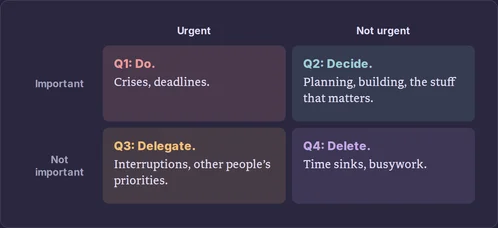
That goat pasture was clearly occupying Quadrant Two in my mind for a long time. By invoking external accountability, I increased the perceived urgency. It made the difference.
I like to think of it as the “Quadrant 1.5 Gambit”.
It’s a thinking framework, a model.
And as the British statistician, George Box, opined, “all models are wrong, but some are useful.”
It doesn’t change human nature and our collective predisposition to focus on what’s in front of us whether it’s urgent, or has an immediate reward or consequence, or even if it’s an easy dopamine hit.
My current Apple Reminders setup is three lists. There’s the default Now list, a Later list, and then there’s a Scheduled list. It’s loosely KanBan shaped.
Predictably, the Later list in particular is a graveyard where to-dos go to die.
I use Microsoft Planner with my team and the KanBan workflow works well because of the shared accountability. Everybody is looking at the buckets together. The momentum of To-do/Doing/Done is real and measurable.
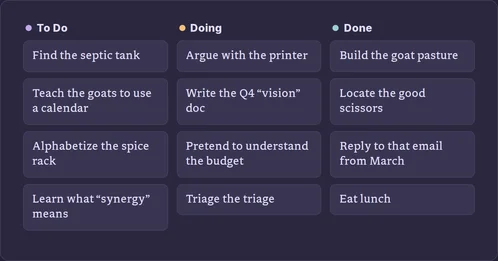
But when it comes to personal accountability for “Getting Shit Done”, the Now/Next/Later temporal mindset isn’t enough. It’s only about what’s in front of me. The proverbial “wolf at the door”. There’s no sense of relative importance. It’s all urgency, all the time.
I think I’ll always struggle with digital to-do lists because they abstract the actual stakes at play. The friction is in the wrong spot. I’ll do the easy stuff or the stuff that has immediate pain. I’m not that disciplined to do otherwise.
Sometimes when I’m overwhelmed and off the rails and planning is a distant memory, I pull out a sheet of paper, and write down all the shit I gotta get done before I die. Dump it out of my head and sync to paper.
That’s a trick too, right? Writing stuff down can often be how it gets it done. It’s a way of externalizing accountability. And there’s a funny thing about paper: it externalizes in a way that’s fundamentally different than Apple Reminders. A piece of paper exists physically in the world, and I get to scratch items off. I could also feed the damn list to my goat. Even that has its own accountability.
With these digital apps, I can hide behind the sorts and filters or even outright ignore the beeps and dings. My capacity for this behaviour is boundless.
When it comes to personal projects and things that are only me, my writing’s a great example. From when the pandemic hit until up to about a year or so ago, I stopped blogging and writing fiction. A dead stop. I had to actively decide to make a hardcore commitment that I was going to blog and write fiction every week, come rain or shine. Perfection wasn’t the goal and I’ve missed a week or two, but I’ve nailed 90% compliance on my commitment.
Is somebody going to be upset with me when I miss a post or I miss a flash fiction? No, of course not. Nobody’s going to hold my feet to the fire. But the simple fact that I’m doing it publicly, that I’ve an imagined readership that reads these things, is what gets it done.
There’s a fundamental difference between habits and routines. Habits are about action. Routines are about identity. Regular writing has become a routine. That is, I am someone who writes and publishes weekly. So maybe that’s the final lever.
I wish that tactic carried to my long-form novel work. I’m sitting on two that are mostly drafted and another three in various states of planning. Some of this work spans fifteen years.
One is a completed first draft and it’s truly terrible. I should rewrite it. But it’s 70,000 words and I haven’t gone back to clean it up and make it something that I could be proud of.
I have to ask myself, why am I not getting that done?
Part of it is they’re big projects. With the way my brain works, big projects are hard to do. I’m great at the start of a project when it’s all novel (pardon the pun) and new, and the ideas are flowing and all of that jazz. And I’m excellent at the tail of a project when I can see the end and I’m ready for that big dopamine rush of completion. But that messy middle though… my god, it’s a grind. I try to break it down into steps and try and find intermediate wins. I haven’t cracked the code so they languish.
My long-form writing doesn’t have any external accountability. No one’s sitting there waiting for me to finish my yarn about a Halifax cop haunted by the ghost of his dead partner’s daughter. Nobody is banging down my door to read my zombie-fightin’ character study. Nobody’s keeping the porch light on waiting for me to finish. This is classic Quadrant Two. It’s only important because I say it’s important, yet I haven’t made it important enough to add the requisite urgency.
What does that say about my identity as novelist?
Quadrant Two is a stinking heaping pile of guilt.
Sharing your ardent commitment publicly or even with one person who cares about you is valid and powerful, but it’s got to be honest and it’s got to be fair. You still have to own your shit. No one has to parent you through your goals.
I do regular periodic reviews and they do hold me to the things that people are counting on me for. This works for me. But if I’m the only one who cares, it doesn’t matter that the novels surface at review time. It doesn’t make a lick of difference. I feel bad about it. And feeling bad isn’t enough.
These are field notes from the void. If you’ve any ideas, why don’t you reach out and let me know? You can either email me, drop me a note on LinkedIn, or even give me a call. I’d love to talk to you about it.